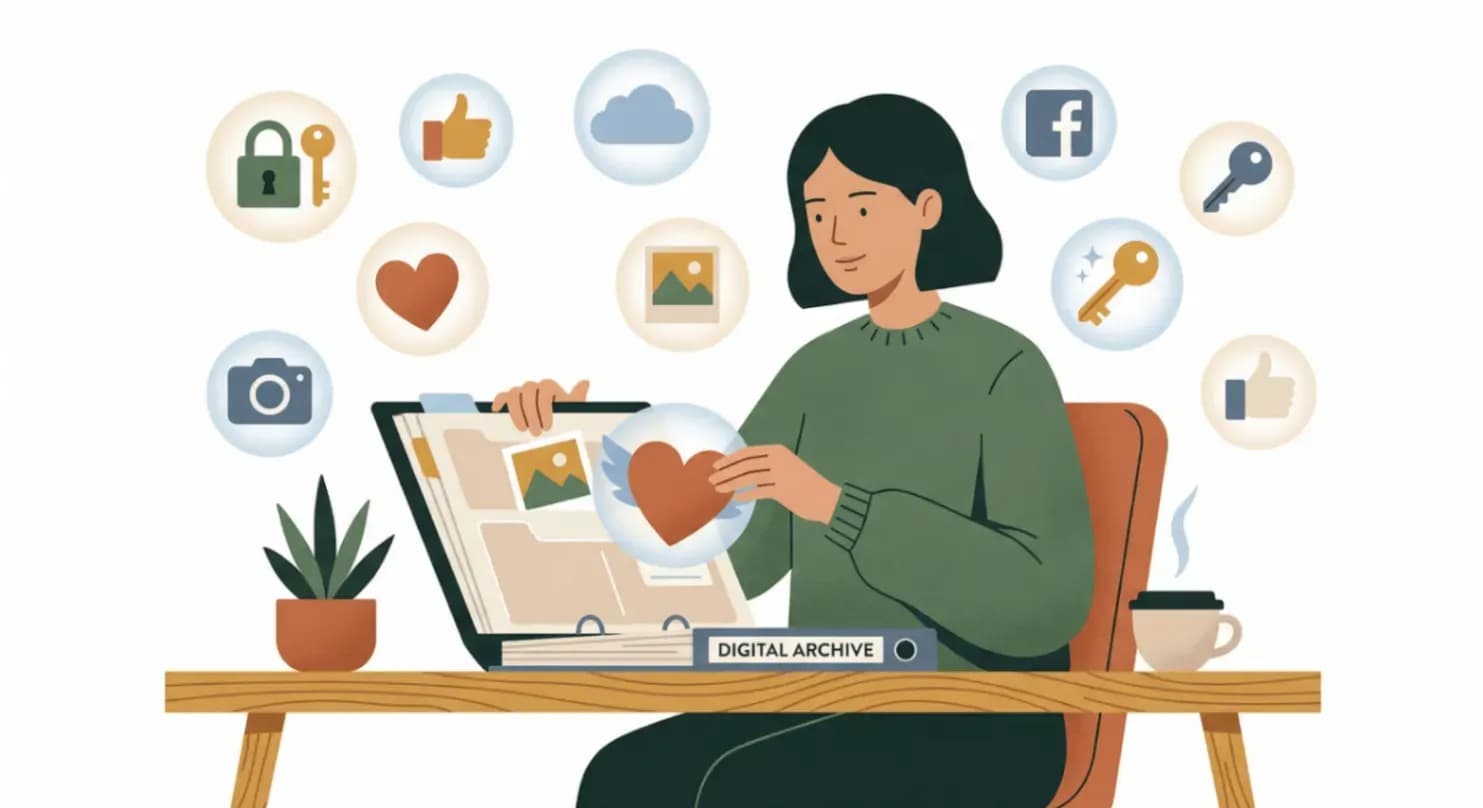
Creating a digital legacy file: how to get started
You probably have dozens of online accounts, from email to streaming services. But what happens to them when you're no longer around? In this article you'll read how to build a digital legacy file step by step, so your loved ones won't be left facing locked digital doors.
Imagine: your partner dies unexpectedly. You want to look back at photos you took together, but they're stored in an iCloud account you don't have the password for. Subscriptions keep charging monthly. And somewhere there might be a crypto wallet with a few thousand euros, but nobody knows where. This isn't a hypothetical scenario. It happens to dozens of families in the Netherlands every day.
In 2025, 173,000 people died in the Netherlands according to CBS (CBS, March 2026). Nearly all of them left behind not just physical possessions, but an entire digital life. That same CBS reports that 96 percent of the population aged twelve and older was online daily in 2025 (CBS, February 2026). Even among the over-75s, that figure has reached 73 percent.
A digital legacy file might sound like something for later, something for when you're "old." But the reality is that anyone with an email address, a banking app and a social media account benefits from sorting this out now. In this article I'll show you how to do that in manageable steps.
What exactly is a digital legacy file?
Your digital legacy is everything you leave behind online after you die. That goes beyond just your Facebook profile. Think of email accounts, cloud storage with photos and documents, active subscriptions, online bank accounts, investment apps, cryptocurrency, webshop accounts and loyalty programmes. Research by BNNVARA's Kassa showed that the average Dutch person has around 25 online accounts (BNNVARA Kassa). In 2026, that number is likely even higher, as more and more services require an account.
A digital legacy file is simply a structured overview of all those digital assets, including your wishes about what should happen to them. Where a physical will determines who gets your house and savings, this file covers the digital side: who gets access to your photos? Should your social media profiles be deleted? Are there still funds in a payment app?
Important to know: legally speaking, an online account isn't property but a licence. You have the right to use a service, but you don't "own" the account in a way that's automatically transferable. The Dutch government confirms this, referring next of kin to the topic of digital legacy on rijksoverheid.nl/overlijden. Dutch inheritance law, set out in Book 4 of the Civil Code, determines who inherits what, but tech companies don't always cooperate when it comes to transferring accounts.
Practical tip: grab your phone and scroll through your installed apps. Count them. You'll probably get past thirty quickly, including banking, insurance, shops and entertainment. That gives you a good sense of the scope.
Why is it more urgent than ever?
There are two reasons why you need to take this seriously in 2026. The first is financial. The costs surrounding a death have risen significantly in recent years. According to Nibud figures, an average funeral used to cost around €7,500, but NOS reported that funeral costs have risen by roughly 40 percent in ten years. Insurers such as DELA now cite an average of €8,000 for a cremation and €10,000 for a burial. Monuta uses a range of €7,000 to €11,500 for a fully customised funeral. On eindstation.nl you can find more information on what DELA and Monuta cover exactly.
The second reason is complexity. In 2026, 14.6 million Dutch people use social media, spread across an average of 4.5 platforms (National Social Media Survey 2026). On top of that come bank accounts, insurance, government portals, cloud storage and streaming services. Without an overview, next of kin spend weeks tracking down, contacting and closing all those accounts. And that's while they're simultaneously organising a funeral, registering the death and settling the estate. Our checklist for when your partner has died shows just how many steps come at you; digital matters are only part of it.
New in 2026: the filing deadline for inheritance tax has been extended from 8 to 20 months after death. More time, but the Tax Authority does charge interest of 10 percent if you're late (Belastingdienst, 2026). Digital assets such as investment apps or crypto must be included in the tax return. If next of kin don't even know they exist, they risk additional assessments.
Practical tip: check whether your funeral insurance still matches current costs. You can see directly what ASR or DELA offer.
Step 1: map out all your digital assets
The first and most time-consuming step is taking inventory. There are four main categories.
First: accounts with financial value. Online bank accounts, investment platforms, crypto wallets, loyalty programmes with accumulated points and payment apps like Tikkie or PayPal. These are the accounts that directly affect your estate. The Consumentenbond points out that banks are allowed to pay necessary funeral costs directly from the frozen account to the funeral director, provided an invoice is submitted (Consumentenbond, inheritance tax 2026). But there does need to be sufficient balance, and next of kin need to know which bank.
Second: accounts with emotional value. Think of Google Photos, iCloud, your email archive and social media profiles with years of memories. For many loved ones, the photos and messages of a deceased person are priceless.
Third: active subscriptions and obligations. Netflix, Spotify, gym memberships, dating apps, news sites, software licences. These keep running until someone cancels them.
Fourth: devices and access. Your phone, laptop, tablet, external hard drives and NAS systems. Without the PIN code of your phone, next of kin can't get anywhere.
Practical tip: start today with a simple list. Open your email and search for "registration confirmation" or "welcome to." You'll get a decent overview of where you have accounts.
Step 2: choose the right storage method for your passwords
This is perhaps the biggest bottleneck. Because an overview of your accounts is useless if nobody can access it. The Consumentenbond recommends using a password manager as the most practical solution: you then only need to hand over the username and master password (Consumentenbond, December 2025). That's not just handy for your legacy, but also for your everyday digital security.
There are several ways to record your login details. A password manager like Bitwarden, 1Password or KeePass stores everything encrypted. You then make arrangements with a trusted person about where the master password can be found. An alternative is a physical list in a sealed envelope at the notary or in a safe at home.
Some major tech companies also offer built-in options. Google has an Inactivity Manager that lets you set what happens to your account if you're inactive for an extended period. Apple offers a Digital Legacy feature that lets you designate contacts who gain access to your iCloud data after your death. Facebook and Instagram let you set up a legacy contact. Platforms like Spotify, Netflix and Amazon don't have such a feature; there the account stops once payment lapses.
Practical tip: set up the Google Inactivity Manager today (found at myaccount.google.com/inactive). It takes five minutes and ensures your Google account doesn't become unreachable forever.
Step 3: record your wishes (and discuss them)
A list of accounts and passwords is the foundation, but it only becomes truly complete when you also record your wishes. Do you want your Facebook profile converted to a memorial page? Or deleted instead? Are next of kin allowed to read your private messages? What should happen to that folder full of holiday photos on Google Drive?
More and more initiatives, such as the "Data after Death" campaign by the Alliantie Digitaal Samenleven, highlight the importance of this topic. On eindstation.nl we have a digital legacy checklist with 12 concrete points to help you record your wishes step by step, from social media and photos to crypto and subscriptions.
You can record your digital wishes in various ways. In a will at the notary is the most watertight option. A living will is another instrument that authorises someone to act on your behalf while you're still alive but no longer able to do so yourself. But formal recording isn't necessarily required for everything. It already helps enormously if you simply create a document in which you describe what you want per account.
The most important thing of all: discuss it with the person who will eventually have to carry it out. Designate someone as your "digital representative" and tell them where everything can be found. Just as you ask someone to be executor of your will, you can ask someone to handle your digital legacy.
Practical tip: schedule fifteen minutes this weekend to discuss this with your partner, child or a trusted family member. A coffee and a short conversation is enough to cover the basics.
Step 4: keep your file up to date
A digital legacy file isn't a one-off task. Accounts change, passwords get updated, subscriptions come and go. If you created your file two years ago and have since switched banks or opened a crypto account, a fair chunk of it is already out of date.
So schedule an annual "digital maintenance moment." This can easily coincide with other annual financial checks, such as reviewing your insurance. ASR and DELA offer online calculators that let you see in a few minutes whether your funeral insurance is still adequate. On eindstation.nl you can find comparison information for ASR and DELA.
Use that moment also to check whether the legacy settings at Google, Apple and Facebook are still correct. Is your contact person still the same? Small things that make a big difference.
Practical tip: set an annual reminder on your phone for 1 January or your birthday, with the text "update digital legacy file." That way you won't forget.
The financial side: what next of kin need to know
Apart from the digital accounts, it's good to understand the financial context. For a death in 2026, the following inheritance tax exemptions apply: partners may inherit up to €828,035 tax-free, children up to €26,230 per person. Above that, partners and children face a rate of 10 percent on the first €158,669, and 20 percent on the remainder. For other heirs the exemption is only €2,769 and the rate is 30 to 40 percent (Belastingdienst, 2026).
Funeral costs are deductible from the estate for inheritance tax purposes. That makes good record-keeping extra important. If there are digital assets (an investment account, bitcoins, PayPal balance), they count towards the estate. Next of kin who don't know these exist may declare too low an amount to the Tax Authority.
Earlier Nibud research showed that one in five Dutch people would not be able to cover a funeral from their savings. Funeral insurance can mitigate that risk. On eindstation.nl you can compare different funeral insurance policies side by side to see which fits your situation.
Practical tip: take your most recent policy and check the insured amount. Does it say €5,000, while your wishes are closer to €9,000? Then it's worth looking into whether additional coverage is an option.
Conclusion: start small, but start today
A digital legacy file sounds like a big project, but it doesn't have to be. Start with a list of your most important accounts. Choose a way to store passwords securely. Write down your wishes and discuss them with someone you trust. The rest is maintenance.
What it really comes down to: your loved ones will already be facing enough decisions and emotions. Every puzzle piece you put in place now is one fewer for them. And that might be the most tangible thing you can do for them. Want to prepare more broadly than just the digital side? Our checklist to prepare your own funeral helps you arrange everything in 11 steps so your loved ones won't face any surprises.
Want to get started right away comparing funeral insurance? Compare the major insurers on eindstation.nl for a clear overview of what they offer in 2026.